An Oscillator-Based AI Model? Naveen Rao’s Un-0 Bets on Rhythm Over Brute Force
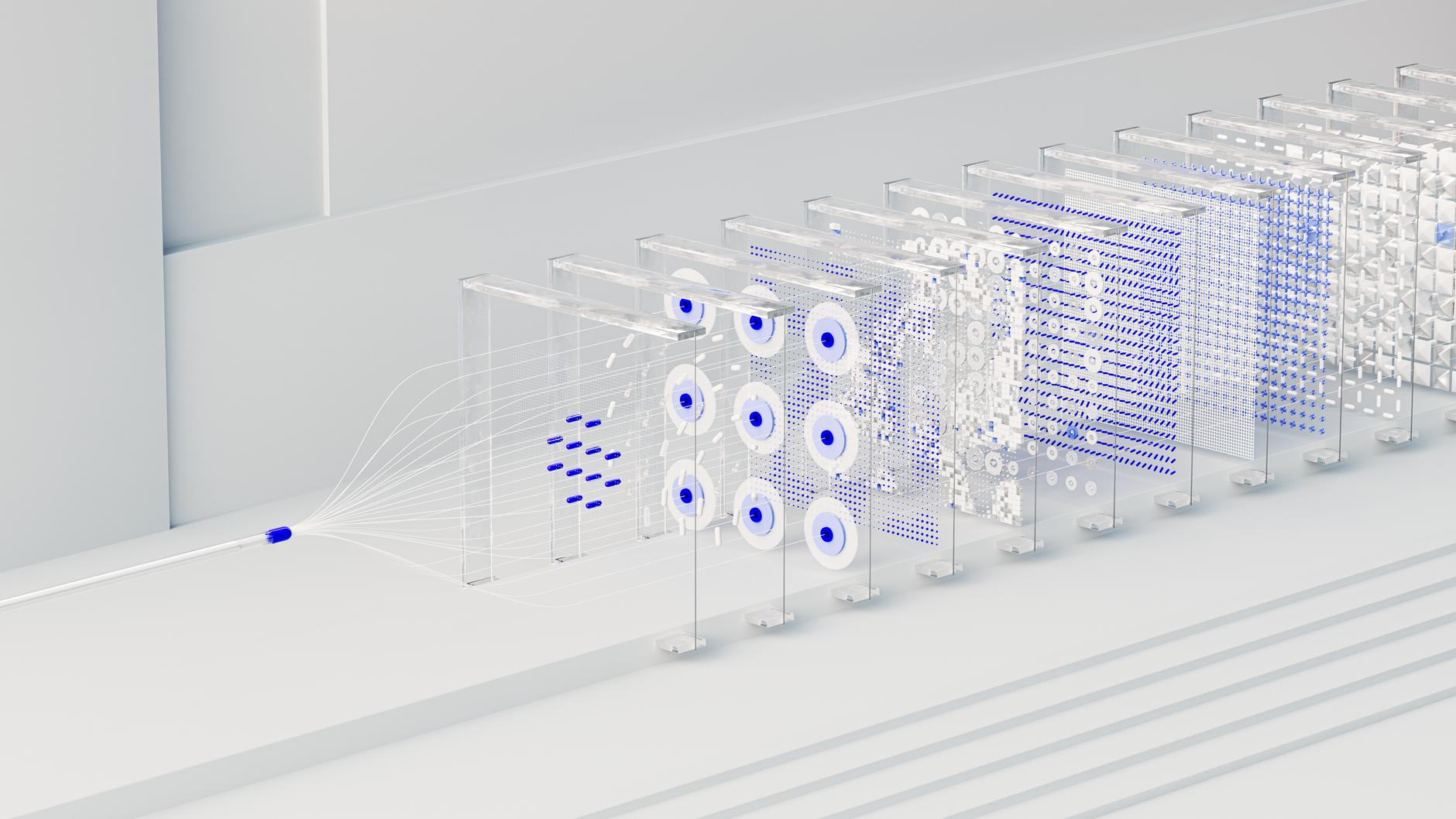
Most AI labs are still chasing bigger transformers, more parameters, and longer context windows. Naveen Rao’s startup just went a different direction entirely. Their new model, Un-0, is built around oscillators — yes, the same physics concept that governs pendulums, radio waves, and firing neurons. If that sounds like a science fair project, the early benchmarks suggest it’s anything but.
What an Oscillator-Based Architecture Actually Means
Standard neural networks process information through static weight matrices and pointwise nonlinearities. Data flows forward (and sometimes backward) through layers, but there’s no inherent notion of time or rhythm. Oscillatory networks change that. Each unit maintains a phase and amplitude, updating continuously based on coupled differential equations. The result: representations that breathe.
Think of it like this. A transformer reads a sentence all at once, attending to every token simultaneously. An oscillator model processes sequentially but with memory encoded in phase relationships — not a separate hidden state vector, but the actual geometry of the oscillation itself. It’s closer to how cortical columns handle sensory streams. Rao’s team isn’t the first to explore this (look up “neural oscillators” or “liquid time-constant networks”), but Un-0 appears to be the first serious commercial push.
Why This Matters for Edge Deployment
The immediate win isn’t benchmark supremacy on H100 clusters. It’s efficiency. Oscillatory dynamics can be implemented with extremely sparse connectivity — each unit only needs to talk to a few neighbors — and the continuous-time formulation means you can step the simulation at whatever resolution your hardware allows. Early claims from the startup cite 10-20x lower FLOPs for comparable sequence modeling tasks.
That opens doors transformers can’t unlock: always-on keyword spotting on a smartwatch DSP, real-time sensor fusion on a drone flight controller, or adaptive noise cancellation in hearing aids without cloud round-trips. Rao’s background in low-power ASIC design (he led the signal-processing team at a major mobile chip vendor before founding this) suggests the hardware co-design angle isn’t accidental.
The Skepticism Checklist
Let’s not get carried away. Several red flags deserve attention:
- Training stability. Coupled oscillators are notorious for bifurcations — tiny parameter changes can flip the whole system into chaos or silence. Gradient descent through that landscape is treacherous.
- Long-range dependencies. Transformers handle “the cat that the dog chased ate the fish” effortlessly. Oscillatory models rely on phase coherence across time; maintaining that over thousands of steps is unproven at scale.
- Software ecosystem. No PyTorch module, no ONNX export, no Triton kernels. If you want to try Un-0 today, you’re likely signing an NDA and getting a Docker image with a custom runtime.
- Benchmark transparency. The press release cites “internal evaluations on standard sequence tasks.” Which tasks? What baselines? Where’s the reproducibility?
None of these are fatal. They’re just the normal toll booths any novel architecture must pass.
Where the Bet Pays Off
If Un-0 delivers even half its claimed efficiency, the first killer app won’t be chatbots. It’ll be always-listening interfaces that don’t drain batteries — the “hey Siri” layer that actually runs on-device, not a wake-word trigger for the cloud. Imagine AR glasses that understand whispered commands for 18 hours on a charge. Or industrial vibration monitors that learn normal machine rhythms and flag anomalies without labeled training data.
Rao’s team is targeting a developer preview in Q1 2026 with a hardware reference design following six months later. That timeline feels aggressive but not delusional. The oscillator math is well-understood; the engineering challenge is making it differentiable, scalable, and compilable to fixed-point silicon.
My take: this is the most interesting architectural left turn since state-space models (Mamba, RWKV) briefly stole the spotlight. Those faded because they couldn’t match transformer quality at scale. Oscillators have a different failure mode — they might scale beautifully but hit a quality ceiling. We’ll know soon enough. For now, Un-0 deserves the attention of anyone building AI that has to live on a battery.
Source: original report